Two products can sit in the same feed with the same photo and price but differ in eligibility or matching because of the data underneath - identifiers, categories, attributes, and labels. Delivery differences can also reflect demand, competition, bids, and campaign configuration, so completeness is one input rather than the sole explanation.
Product data enrichment is the work of closing that gap: taking the minimal data your store exports and building it out into what platforms actually reward. Not to be confused with enriched catalog ads, which enrich the creative - this is about enriching the data itself. The two compound, but they're different layers.
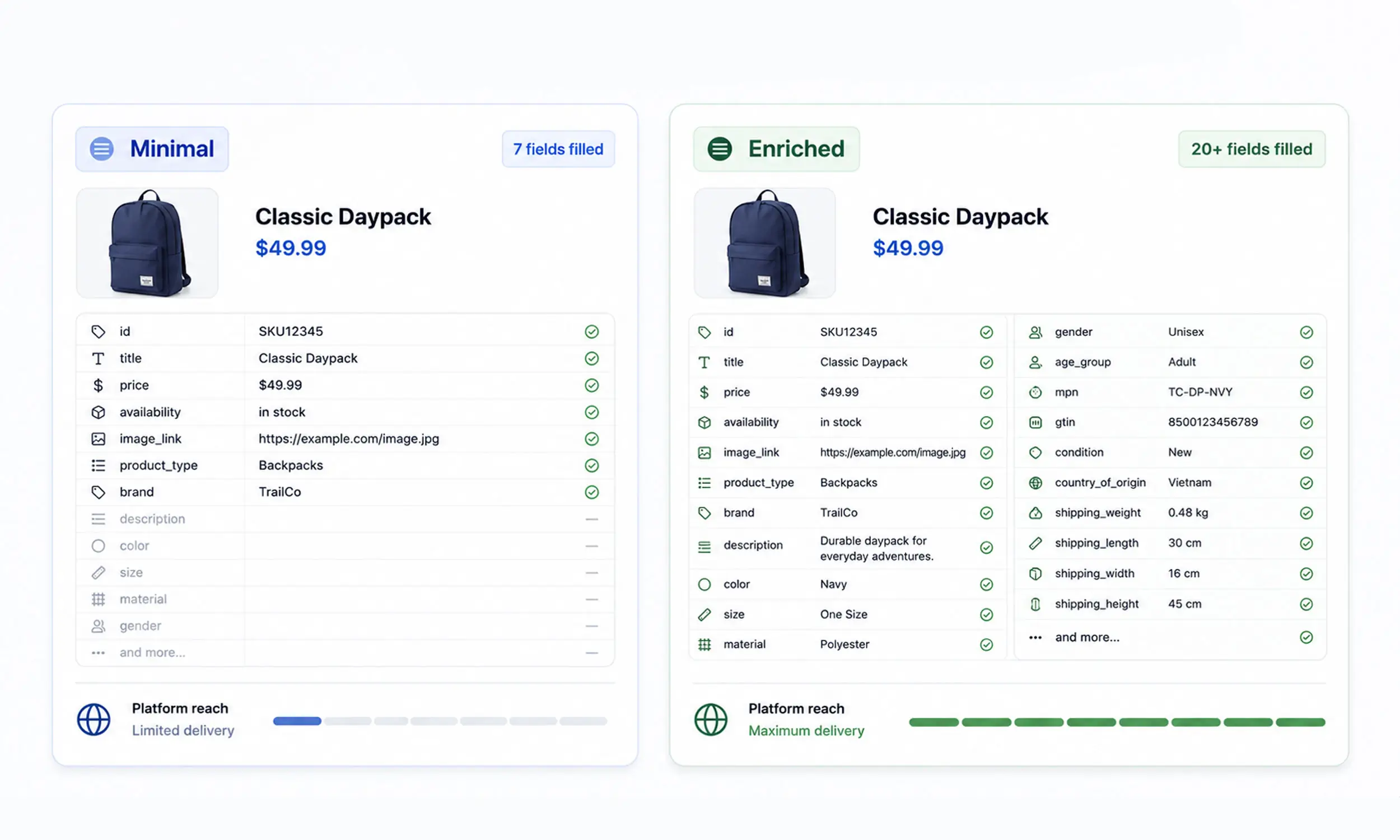
What enrichment actually buys you
Platforms use feed data for three things beyond display, and each one pays for enrichment differently:
Matching and distribution - categories, attributes, and identifiers determine which queries, audiences, and surfaces a product is eligible for. Sparse data narrows eligibility silently.
Approval - missing identifiers and thin data are among the most common causes of limited delivery and outright rejections.
Buyer trust downstream - the data becomes the ad and the listing. In Salsify's 2025 research, 53% of shoppers abandoned purchases over incomplete or poorly written titles and descriptions.
Prioritize enrichment by eligibility and matching impact rather than alphabetically or cosmetically. The sequence below is a defensible starting point, subject to destination diagnostics and category needs.
The priority ladder
1. Identifiers first: GTIN, brand, MPN
Valid GTINs are high-value identifier fields where they apply: they improve product matching, while invalid values can cause rejections. Fill them from authoritative barcode data, validate before publishing, and do not invent one for a product that legitimately has none.
2. Categories: the platform taxonomy
google_product_category - used by Meta, TikTok, and Pinterest alike - 2 to 3 levels deep, mapped once per store category via feed rules. Your own product_type path alongside it. Categories are eligibility: an unmapped product competes in nothing.
3. Variant structure
item_group_id grouping, with per-variant color, size, gender, and age_group. Ungrouped variants either compete with each other or collapse into one arbitrary listing; grouped ones let platforms show the right variant to the right buyer - and power "complete the look" style catalog creative.
4. Titles and descriptions
Now the visible layer: brand-first titles with the key attribute, truncation-safe; descriptions that read like product copy, not keyword lists. The title formula rule applies this catalog-wide in one pass.
5. Labels: your own taxonomy
Margin bands, bestsellers, seasons, lifecycle - the custom-label vocabulary that makes segmentation and creative selection possible. Platforms don't require these; your strategy does.
6. Trust extras
Ratings fields where supported (average_review_rating and number_of_reviews on Pinterest), additional images up to each platform's cap, and product video links can enrich a listing. Add them only from maintained sources and measure their effect.
Priority | Rung | Key fields | Payoff |
|---|---|---|---|
1 | Identifiers first |
| Matching |
2 | Platform categories |
| Eligibility |
3 | Variant structure |
| Accuracy |
4 | Titles & descriptions | Brand-first title, key attributes, product description | Clicks |
5 | Custom labels | Margin, bestseller, season, lifecycle labels | Strategy |
6 | Trust extras | Ratings, review count, additional images, video | Trust |
Where enrichment data comes from
In rough order of preference:
Data you have but don't export - barcodes, cost fields, vendor names, size charts living in your store or ERP but missing from the feed. Most "enrichment" is really just plumbing.
Data you can compute - margin bands from costs, seasons from categories, bestsellers from order history. Rules, not typing.
Data you can standardize - free-text colors ("Navy-ish blue") normalized to platform vocabularies
Data someone must create - genuinely missing attributes. This is the expensive tier; scope it to your revenue-weighted top products first, not the whole catalog alphabetically.
And the anti-source: scraping or inventing values to fill columns. Incorrect data can mislead buyers, create landing-page mismatches, and trigger product disapprovals; leave a field empty when it is optional and cannot be supported.
Enrichment by vertical, briefly
Where the leverage sits differs by what you sell:
Fashion - variant structure and size/color completeness dominate; a well-grouped apparel catalog is halfway to campaign-ready
Beauty - identifiers (heavily GTIN-checked category) and ingredient-bearing descriptions
Home and furniture - categories and dimension attributes; buyers filter hard
Electronics - GTIN/MPN precision above all; matching against known products is the game
Measuring whether it worked
Enrichment shows up in boring metrics before exciting ones, in this order:
Rejection and warning counts fall (check your audit numbers)
Eligible-product counts and impressions rise as matching widens
CTR moves as titles and trust extras improve what renders
ROAS follows, lagging by a conversion window
Benchmark the top-priority fields' fill rate - percentage of products with valid GTIN, mapped category, complete variants - and track it like a KPI. It's the leading indicator everything else trails.
Carrying enriched data into distribution and creative
Enrichment creates value only when better data survives the trip to the destination. Flow's catalog engine maps, validates, previews, and monitors catalog fields, while the creative studio can use supported product data in reusable templates and variations.
That creates a path from authoritative source data to both distribution and creative—not permission to invent missing values. Confirm each computed field and binding, inspect the output, and let destination diagnostics verify that the enriched product remains eligible.
FAQ
What is product data enrichment?
Systematically completing and improving the product attributes in your feed - identifiers, categories, variants, titles, labels, ratings - so platforms can match, approve, and display products fully.
Is this the same as enriched catalog ads?
No - that's the creative layer (prices and badges rendered into ad visuals). Data enrichment improves the underlying fields. They compound: enriched data makes enriched creative more accurate.
What should I enrich first?
Identifiers (GTIN/brand/MPN), then platform categories, then variant structure. They gate eligibility and approval; everything else optimizes within them.
Can enrichment be automated?
Mostly. Exporting hidden store data, computing labels, and normalizing values are rules-work. Only genuinely missing attributes need human creation - scope those to top sellers.
How do I know enrichment is paying off?
Watch fill rates as the leading KPI, then rejections falling, impressions widening, CTR moving, ROAS last. If rejections and impressions don't move, you enriched the wrong fields.
Final thoughts
Product data enrichment is unglamorous compounding: every field you fill correctly works on every impression of every campaign from now on. Follow the ladder - identifiers, categories, variants, then the visible layers - source data honestly, and measure fill rates like they matter, because they do.
The catalog you enrich this quarter is the distribution you don't have to buy next quarter.
TAGS


Join The Newsletter
Stay ahead in catalog advertising
Get practical guides, product updates, new templates, and best practices for Dynamic Product Ads, creative automation, and ecommerce marketing.
On this page
Related articles


Launch catalog ads with ease
Ready to launch better catalog ads?
Turn product catalogs into publishing-ready creatives in minutes.