Most store visitors leave without buying - the Baymard Institute's long-running meta-study puts average cart abandonment at 70.22% - and retargeting exists because a meaningful share of them weren't saying no, just not yet. Facebook retargeting for ecommerce is how you re-enter that conversation with the exact products the visitor already chose to look at.
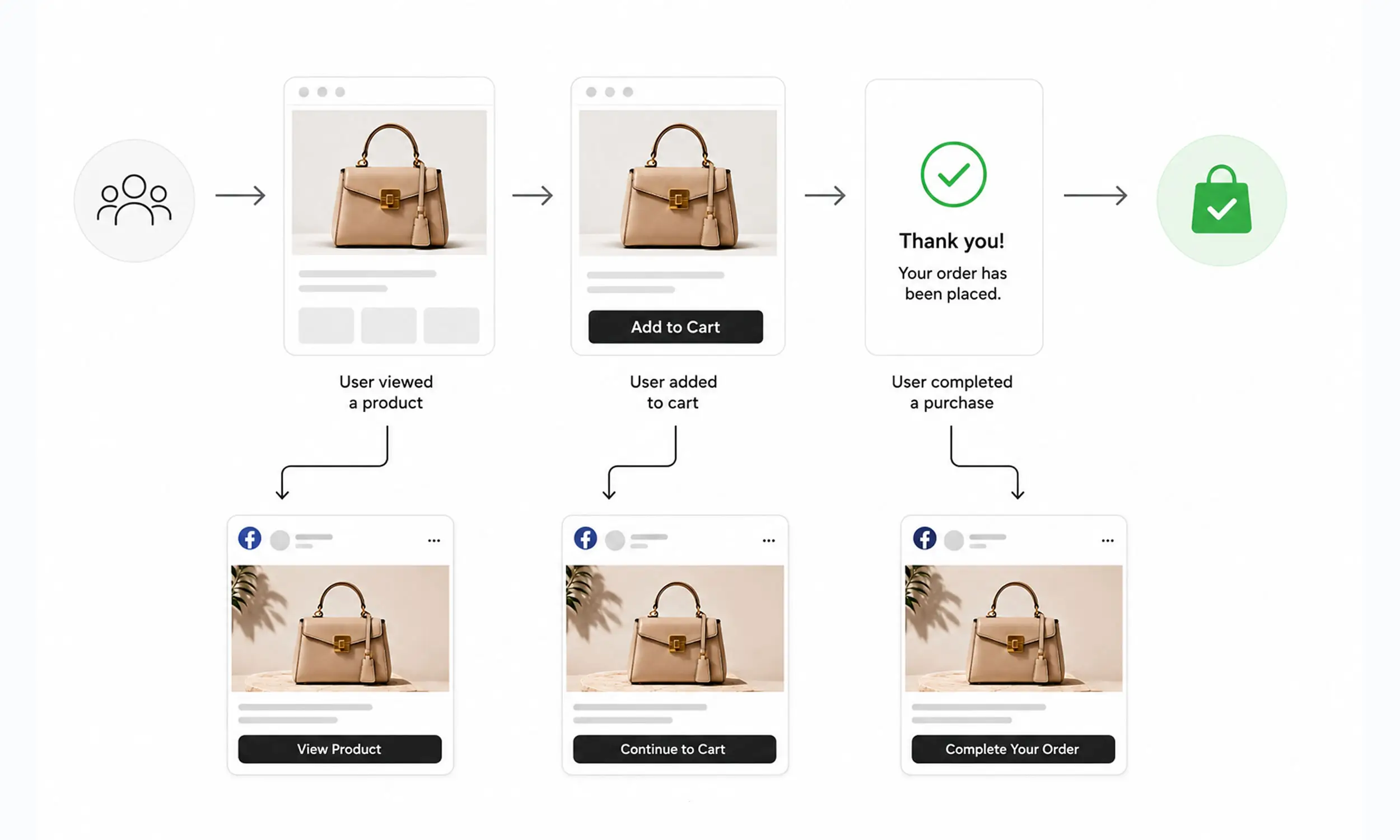
The engine behind it is dynamic product ads: pixel events feed browsing behavior in, the catalog feeds products out, and delivery matches them. This guide covers the setup that has to be true, then nine strategies layered on top of it.
The foundation: signals and catalog
Retargeting quality is decided before any campaign exists, by two inputs:
Pixel events with product identity. ViewContent, AddToCart, and Purchase must fire with
content_idvalues that match your catalog IDs exactly - case included. This is the join that lets Meta show the viewed product; when it silently breaks, retargeting degrades into generic delivery. Verify in Events Manager against the feed, and re-verify after any platform or theme change.A catalog worth re-showing. Current prices, in-stock accuracy, and no rejected products - a retargeting ad with yesterday's price is worse than no ad, because this audience remembers what they saw.
With Advantage+ increasingly blending audience boundaries, your retargeting edge is input quality plus the strategy layer below - not audience micro-carving.
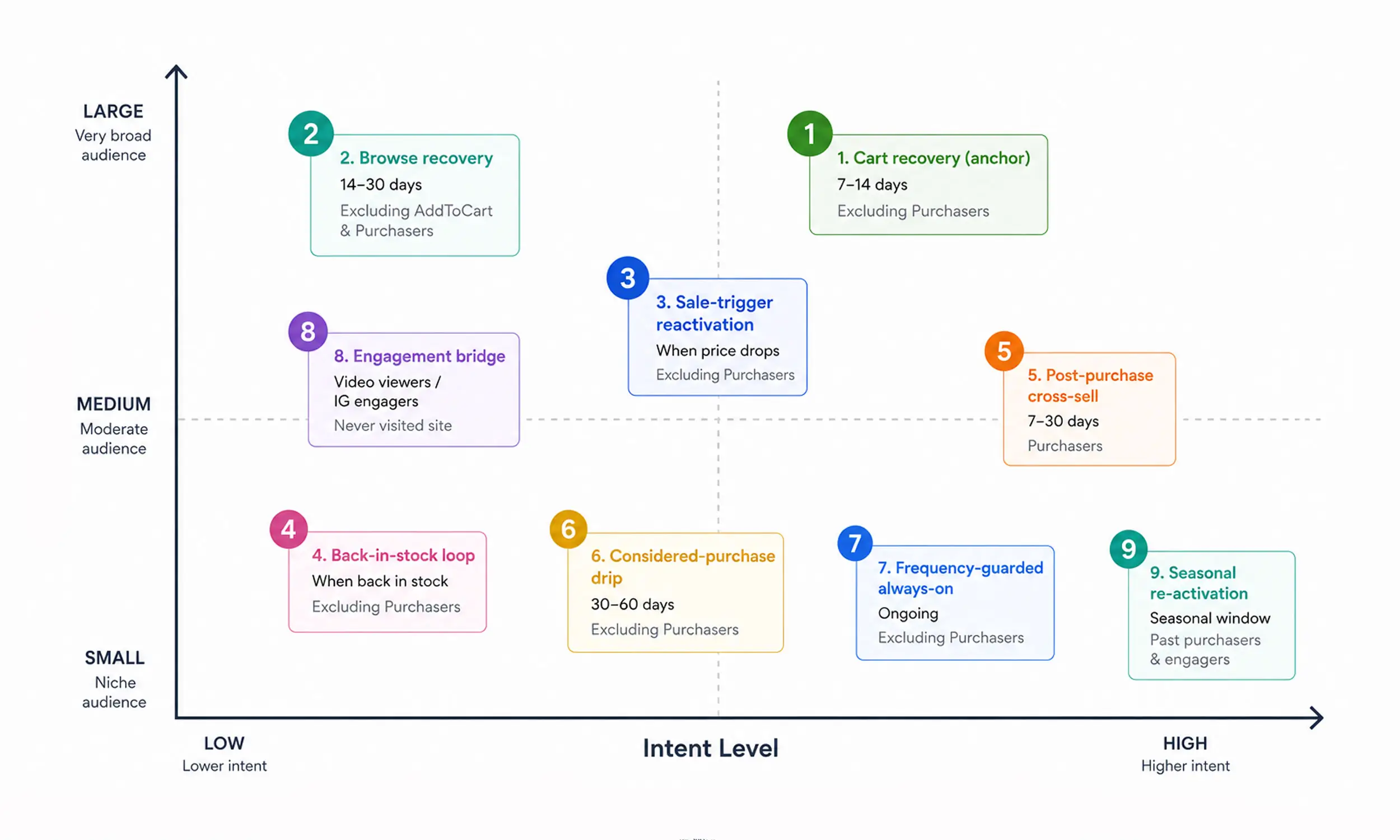
The nine strategies
1. Cart recovery, the anchor
AddToCart in the last 7-14 days, purchasers excluded, showing the exact carted products. This is a high-intent audience, but whether it merits an always-on campaign depends on audience size, incrementality, and unit economics. Keep the creative confident rather than desperate - product, price, one gentle nudge.
2. Browse recovery with a wider net
ViewContent 14-30 days, cart-adders and purchasers excluded. Lower intent than cart recovery, far larger volume. This is where showing similar products alongside viewed ones earns its keep.
3. The sale-trigger reactivation
When a viewed product's sale_price goes live, a strikethrough render can show the price change clearly. Test this reactivation trigger against your standard retargeting treatment, and keep it synchronized through feed rules.
4. The back-in-stock loop
Viewers of products that went out of stock, retargeted when availability flips back. This can be a small, specific audience; measure it separately rather than assuming a conversion-rate advantage. It needs availability discipline in the feed and a restock label to trigger the treatment.
5. Post-purchase cross-sell
Purchasers (7-30 days out) shown complementary sets - not the thing they bought, and not too soon. Build the sets from category logic or "bought together" data; exclude the purchased category where it makes sense. This is where retargeting becomes lifetime-value work.
6. The considered-purchase drip
For high-ticket categories with long cycles: extend windows to 30-60 days, rotate creative angle over time - product first, proof (ratings, bestseller framing) second, offer last. One template system, three template variants, scheduled by recency.
7. Frequency-guarded always-on
Whatever the strategy, cap the pressure: purchaser exclusions everywhere, sensible windows, and creative rotation when frequency climbs. Retargeting fatigue is real and reads as brand damage - the fix is the same template rotation discipline as everywhere else, on a shorter clock.
8. The engagement bridge
Video viewers and Instagram engagers who never reached the site - retargeted with catalog carousels as a bridge to first visit. This is not strictly site retargeting, and its cost and quality should be reported separately from cart or browse recovery.
9. The seasonal re-activation
Past purchasers and engagers, re-approached ahead of the season they bought in last year (holiday gifting, summer). The audience exists in your data already; the campaign is a calendar entry plus a seasonal template.
Windows and exclusions, the short version
Windows follow your purchase cycle: 7-14 days for impulse categories, 30-60 for considered ones. When in doubt, shorter for carts, longer for views.
Exclusions are half the strategy: purchasers out of acquisition-priced campaigns, cart-adders out of view campaigns (they have their own), and each strategy out of the others so they don't bid against themselves.
Let the platform optimize within the guardrails, then compare consolidated delivery with any manual segmentation using the same objective and measurement window.
Measuring honestly
Retargeting reports flatter themselves - it reaches people already likely to buy. Keep two habits:
Watch incrementality proxies: what happens to total conversions when retargeting pauses briefly, not just the campaign's own ROAS
Split reporting by strategy: cart recovery's numbers should never average together with engagement-bridge prospecting-adjacent work - they answer different questions
And keep frequency in every report. It's the early-warning gauge for the whole system.
Connecting catalog changes to retargeting creative
Retargeting becomes more relevant when the ad can respond to what changed in the catalog: a price drop, a restock, a seasonal group, or a fresh creative treatment. Flow connects synchronized product data, collections, reusable templates, and product-driven creative, providing the upstream workflow those strategies need.
Confirm the field bindings and triggers available in your workspace, then keep the audience logic where it belongs. Meta still owns event matching, eligibility, exclusions, delivery, and attribution; incrementality still has to be measured rather than inferred from reported ROAS.
FAQ
What is Facebook retargeting for ecommerce?
Showing your site visitors the specific products they viewed or carted - powered by pixel events joined to your product catalog through dynamic product ads.
What retargeting window should I use?
Match your purchase cycle: 7-14 days for cart recovery in impulse categories, out to 30-60 days for considered purchases. Shorter for carts, longer for views.
Why is my retargeting showing wrong or generic products?
First check the content_id join: pixel events must pass IDs that match the catalog, case-sensitively. Also check product eligibility, availability, event quality, and catalog freshness before concluding the issue is creative or delivery.
Is retargeting still effective with Advantage+ automation?
Yes - the boundaries blur, but the inputs matter more than ever: clean event data, an accurate catalog, honest exclusions, and creative that rewards a second look.
How do I stop retargeting from annoying people?
Purchaser exclusions everywhere, frequency monitoring, capped windows, and template rotation on fatigue signals. The goal is a well-timed reminder, not a pursuit.
Final thoughts
Retargeting reaches a subset of people who previously interacted with the store; Baymard's 70.22% figure describes cart abandonment across studies, not the share a campaign can recover. Build the join properly, keep the catalog honest, use real exclusions, and evaluate incremental conversions rather than attributed ROAS alone.


Join The Newsletter
Stay ahead in catalog advertising
Get practical guides, product updates, new templates, and best practices for Dynamic Product Ads, creative automation, and ecommerce marketing.
On this page
Related articles


Launch catalog ads with ease
Ready to launch better catalog ads?
Turn product catalogs into publishing-ready creatives in minutes.