Every store with a product catalog runs into the same structural problem. The catalog holds everything you sell - and a campaign, to work, needs to say something specific to someone specific. "Everything we sell" is not a message.
The default answer is to run catalog ads on the full catalog and let the algorithm sort it out. For retargeting, that's often fine - the shopper already picked the products by browsing them. But the moment you want to put budget behind bestsellers, run a seasonal push, or clear end-of-line stock, the full catalog is the wrong unit. You need a handle on part of it.
That handle is a collection: a named group of products that exists between the catalog and the campaign. Organize the catalog into collections once, and every campaign after that starts from a group that already means something - instead of a filter someone rebuilds each time.
This piece is about that layer: what to group by, how groups become campaigns, and why the groups should maintain themselves.
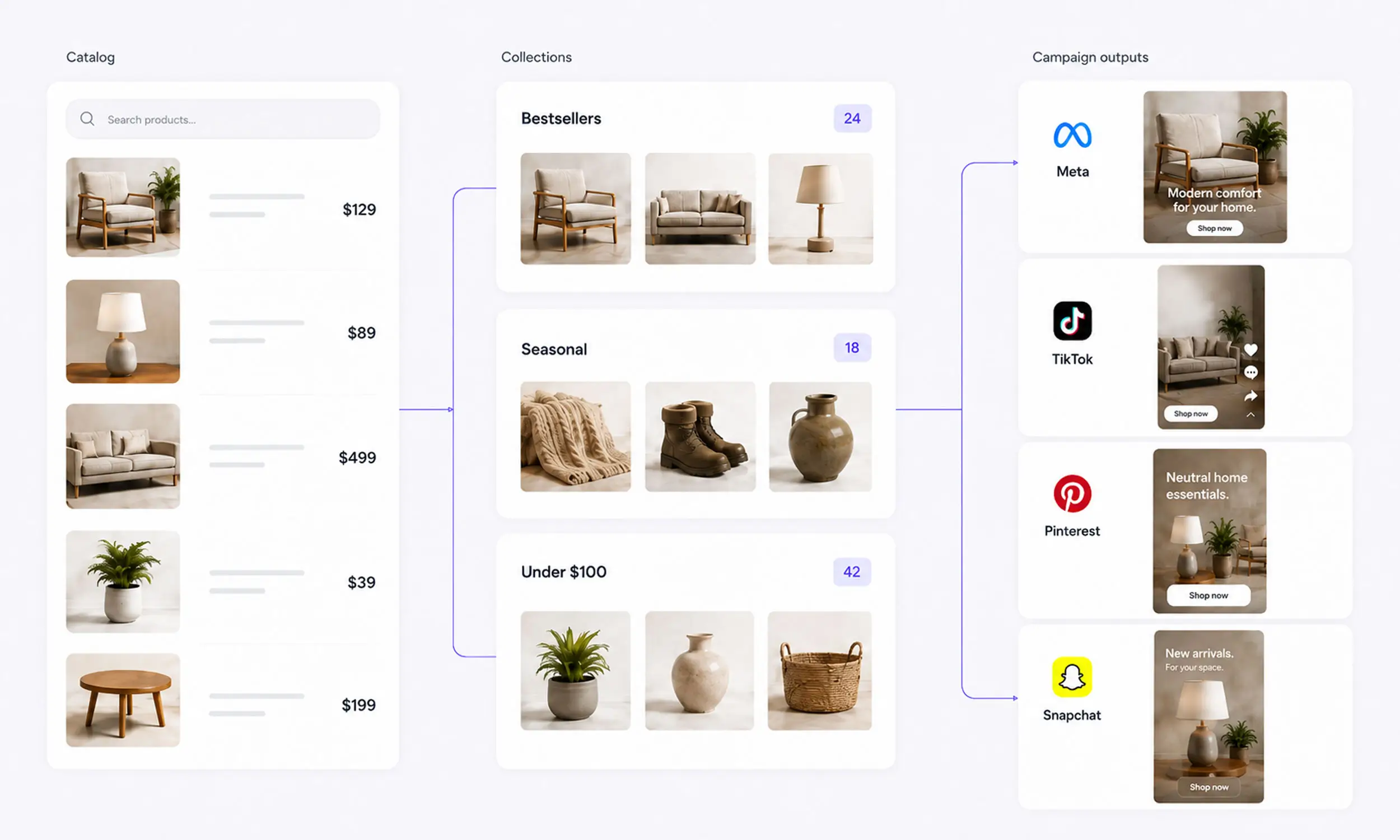
The layer between the catalog and the campaign
A catalog answers "what do we sell?" A campaign answers "what are we saying, to whom, this month?" Those are different questions, and pointing one directly at the other flattens every campaign into the same shape.
Collections sit in between and translate. Each one names a slice of the catalog that a campaign could be about - the bestsellers, the summer range, the gifts under a price point, the clearance rail. Once the slice has a name, it can have its own budget, its own audience, and its own look.
The catalog stays one thing. The campaigns stop being one thing.
Group by shopper intent, not warehouse logic
The trap is to mirror your existing taxonomy - department, supplier, product type - because it's already there. Warehouse logic describes how you store products. Collections should describe how people shop for them. Four groupings cover most stores:
Bestsellers - the products with proof behind them, worth prospecting budget and the front of every campaign
Seasonal - the summer range, the holiday window, the back-to-school push; products whose moment is now
Price role - entry-level pieces that open relationships, premium pieces that anchor the brand, clearance that needs to move
Category-as-intent - a category earns its own collection when it matches a real shopping mission, like "gifts for kids" or "office setup"
These overlap on purpose. A bestselling summer dress belongs in the bestsellers collection and the summer collection - and each membership makes it addressable in a different campaign, doing a different job.
Collections become product sets - and product sets become campaigns
On Meta, a collection has a direct counterpart: the product set, the subset of a catalog that a campaign or ad set actually advertises. Define your collections well and the product sets fall out of them - each one pointing a campaign at exactly the slice it should promote.
That mapping is what makes collections operational rather than decorative:
Budget becomes assignable - bestsellers can carry the prospecting spend while clearance runs lean, a split you can't express against one undifferentiated catalog
Audiences become matchable - the premium collection can meet lookalikes of past high-value buyers; the entry-level collection can meet cold traffic
Timing becomes controllable - the seasonal collection's campaign has a start and an end, while the evergreen collections keep running underneath
The same idea carries to other platforms' campaign structures - the names differ, the pattern doesn't.
One collection, one creative treatment
Grouping doesn't only decide who sees which products - it decides what the products wear. A collection is the natural unit for a creative treatment: one template applied across every product in the group.
The seasonal case makes it concrete: a back-to-school collection carries a back-to-school template - the palette, the badge, the framing - and every product in it renders in that skin while the rest of the catalog stays evergreen. The clearance collection wears a price-forward design; bestsellers wear the brand frame. A wardrobe per collection.
Because the treatment lives in a template rather than in per-product images, changing a collection's look is one decision - and rotating creative when it fatigues is a swap, not a production cycle.
Rules beat hand-picking
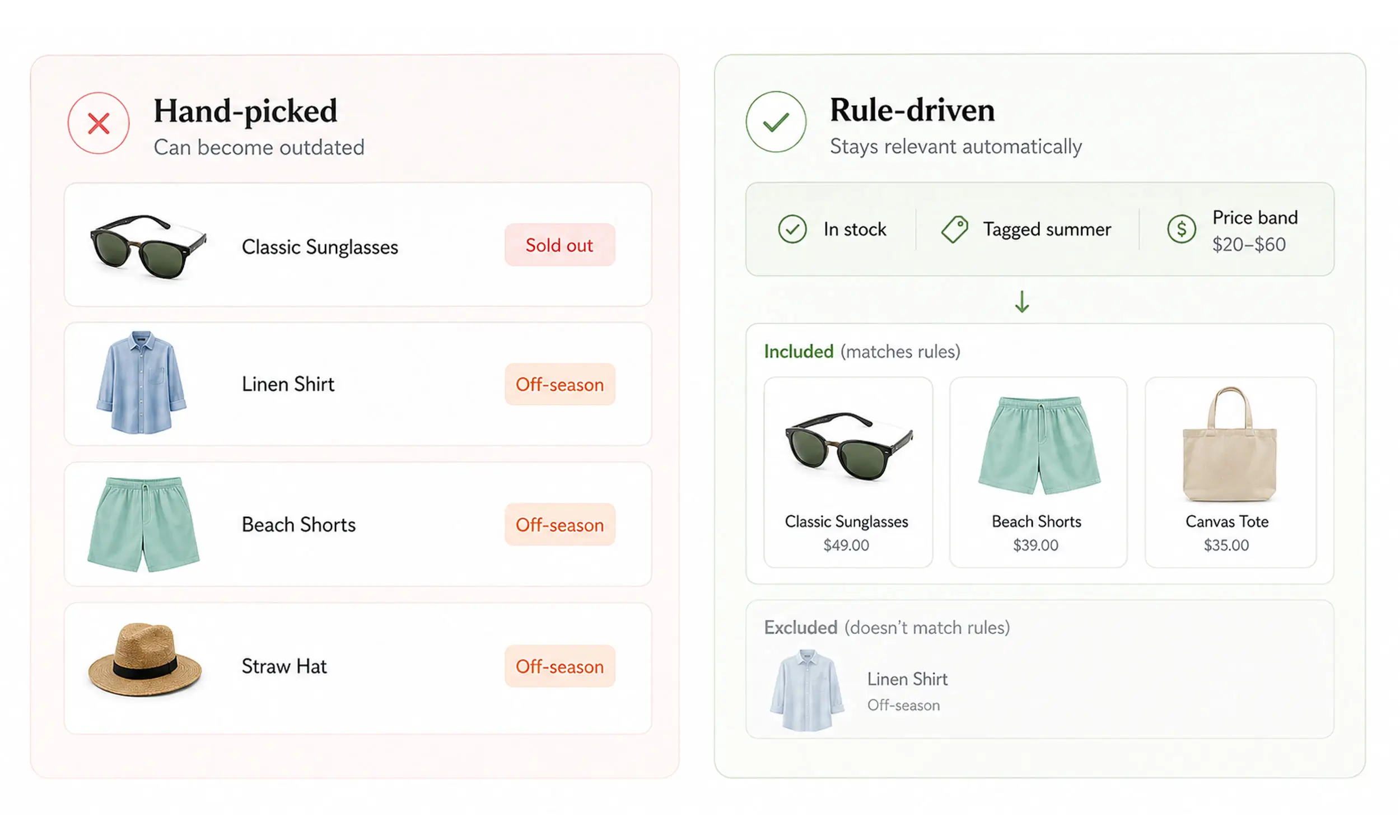
There are two ways to fill a collection: pick the products by hand, or write a rule and let membership follow the data.
Hand-picking feels precise and ages badly. The bestseller list drifts as sales shift. Sold-out products linger in the summer push. New arrivals miss every collection they belong in, because adding them is a task someone has to remember. A curated list is a snapshot - and catalogs don't hold still.
A rule-driven collection is a standing query instead: in stock, tagged for the season, inside a price band, flagged as a top seller. Products enter when they qualify and leave when they stop, each time the feed updates. The collection stays true without anyone touching it - which is the "organize once" half of this article's title actually cashing out.
Rules are only as good as the fields they read, so this is where feed quality quietly pays off: consistent tags, categories, and availability data are what make membership rules trustworthy.
Hand-curation keeps a role - a hero edit, a founder's-picks set - but it should be the exception with a reason, not the default.
Collections in Flow: one grouping, two jobs
In Flow, collections are where organization meets both halves of the workflow. A collection defines the group - by rule or by hand - and that same group connects to targeting on one side and creative on the other: it can drive the product set a platform campaign advertises, and it carries the template treatment its products render with. Group once, and both decisions are made.
That's the shape of the Moeto Detstvo setup: a children's retailer with 400+ products organized into 15+ collections, each promotional push addressing its own slice of the catalog with its own creative. The catalog was imported and mapped once; from then on, the collections did the campaign-shaping.
Underneath, the catalog engine keeps memberships honest - synchronized updates flow through, so a rule-driven collection reflects the store as it is, not as it was when someone last edited a list.
FAQ
What is a collection in catalog advertising?
A named group of products sitting between the full catalog and a campaign - bestsellers, a seasonal range, a price tier. It gives each campaign a specific slice to advertise instead of everything at once.
How is a collection different from a Meta product set?
A product set is Meta's mechanism for advertising a subset of a catalog; a collection is the organizing idea that decides what belongs in it. A well-built collection becomes a product set on Meta - and the same concept travels to other platforms.
How many collections should a store start with?
Start from the campaigns you actually intend to run and work backwards - typically a bestsellers group, the current seasonal range, and one price-role group such as clearance. Add more when a planned campaign has no slice to point at.
Should collections be rule-based or hand-picked?
Rule-based by default: membership follows the feed, so sold-out products drop out and new arrivals join without manual edits. Reserve hand-picking for deliberate edits a rule can't express.
Can one product belong to several collections?
Yes, and it usually should - a bestselling summer item sits in both the bestsellers and seasonal groups, playing a different role in each campaign.
Final thoughts
An unorganized catalog can only make one argument, to everyone, all the time. Collections are how it learns to make several - each with its own products, budget, audience, and look - without the catalog itself changing at all.
The work is front-loaded and mostly thinking: name the slices that match how your customers shop, write rules so the slices maintain themselves, and pair each slice with a treatment. After that, launching a campaign starts from a group that already exists - which is what "organize once, campaign forever" means in practice.
TAGS


Join The Newsletter
Stay ahead in catalog advertising
Get practical guides, product updates, new templates, and best practices for Dynamic Product Ads, creative automation, and ecommerce marketing.
On this page
Related articles


Launch catalog ads with ease
Ready to launch better catalog ads?
Turn product catalogs into publishing-ready creatives in minutes.