Every ecommerce advertiser knows the rhythm: a creative launches, performs, plateaus, and decays. Frequency climbs, CTR slides, costs creep. The standard response is to make new creative - and for most teams that means a weekly production cycle of fresh single-image ads, or a scramble every time frequency crosses a threshold.
That treadmill is the real cost of ad fatigue. Not the decayed ad - the permanent production tax of replacing it, one image at a time, forever.
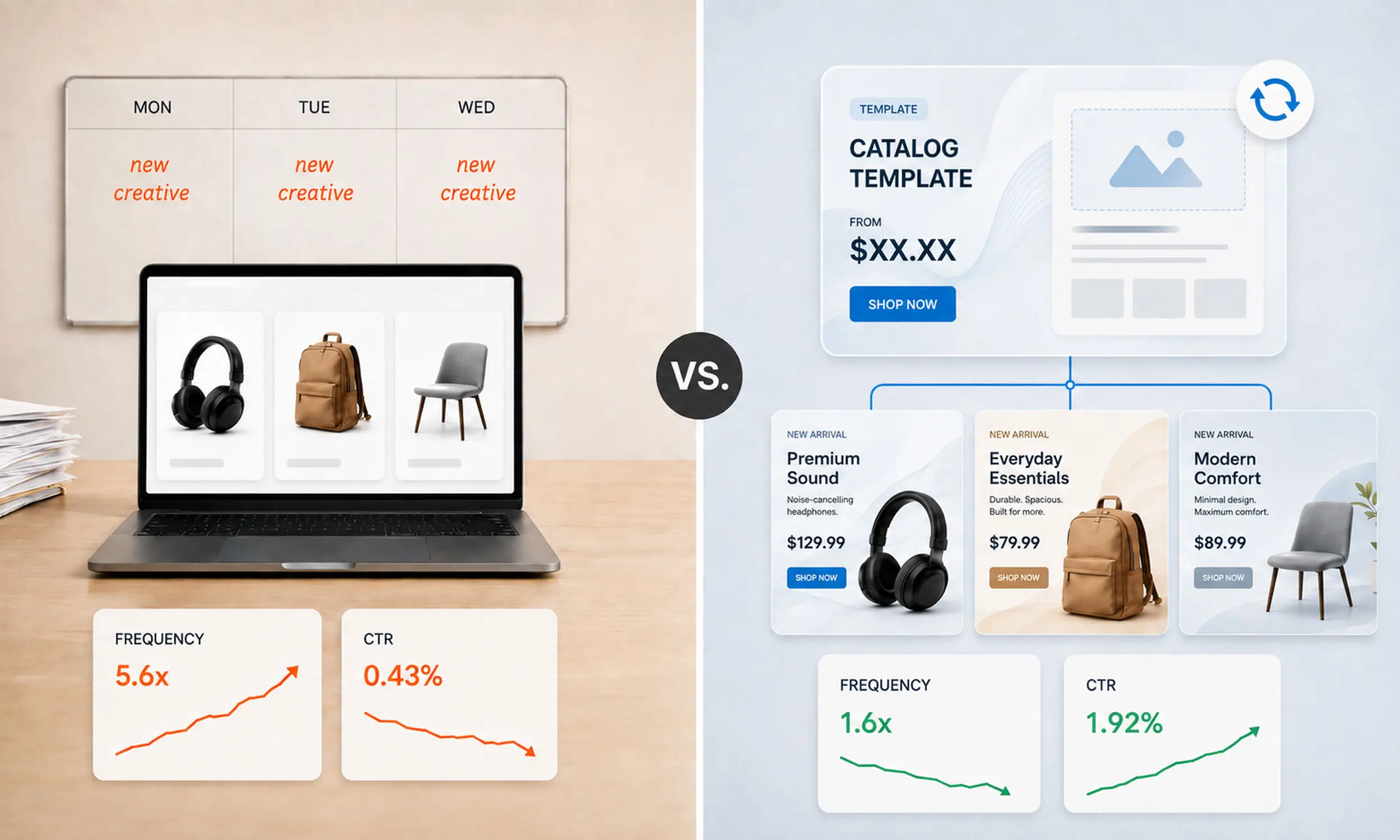
Catalog advertising offers a different deal, and it's the reason this article exists: when your ads render from templates, refreshing creative means changing the template - once - and every product in the campaign wears the new design. Testing a new creative direction stops being a week of production and becomes a few days of running it live on the catalog.
What ad fatigue actually is
Fatigue is an audience effect, not an ad defect: the same people seeing the same creative too many times, with each exposure worth less than the last. The signals are unglamorous and reliable:
Frequency climbing while reach flattens
CTR decaying from its early baseline
Cost per result drifting up with no targeting or market change to blame
None of these need a dashboard ritual - a weekly glance at frequency and CTR trendlines per campaign is enough to catch the pattern early. What matters is having a planned response, because the unplanned one is what burns teams: pausing winners, rebuilding campaigns, and resetting learning phases to escape a problem that was only ever about the pixels.
The single-image treadmill
For non-catalog campaigns, the standard fatigue playbook looks like this: produce a batch of new statics, launch them alongside the incumbents, watch for a winner, retire the losers, repeat - weekly for some teams, or reactively whenever frequency crosses an internal line.
It works, but look at what it costs:
Every refresh is a production event - design, review, export, upload, again
Testing is slow by construction - each new direction needs its own asset batch before you learn anything
It doesn't scale with the catalog - the treadmill produces hero creative for a handful of products while the other hundreds keep running stale
The pressure never ends - fatigue is recurring, so the production tax is recurring
Teams don't fail at this because they're lazy. They fail because the math is against them: creative demand is continuous, and hand production is batchy.
The catalog alternative: refresh the template, not the ads
In a catalog campaign built on reusable templates, the creative layer is separated from the products. The design - background, price treatment, badges, brand frame - is one artifact; the products flow through it.
That flips the fatigue economics:
A refresh is one design change - swap the template variant, and every product in the set re-renders with the new look. A hundred-product campaign refreshes as one action, not a hundred exports.
Testing is fast and honest - run a new template on the catalog for a few days against the incumbent, same products and budget, and read CTR directly. You're testing the design itself across the whole assortment, not one hero image's luck.
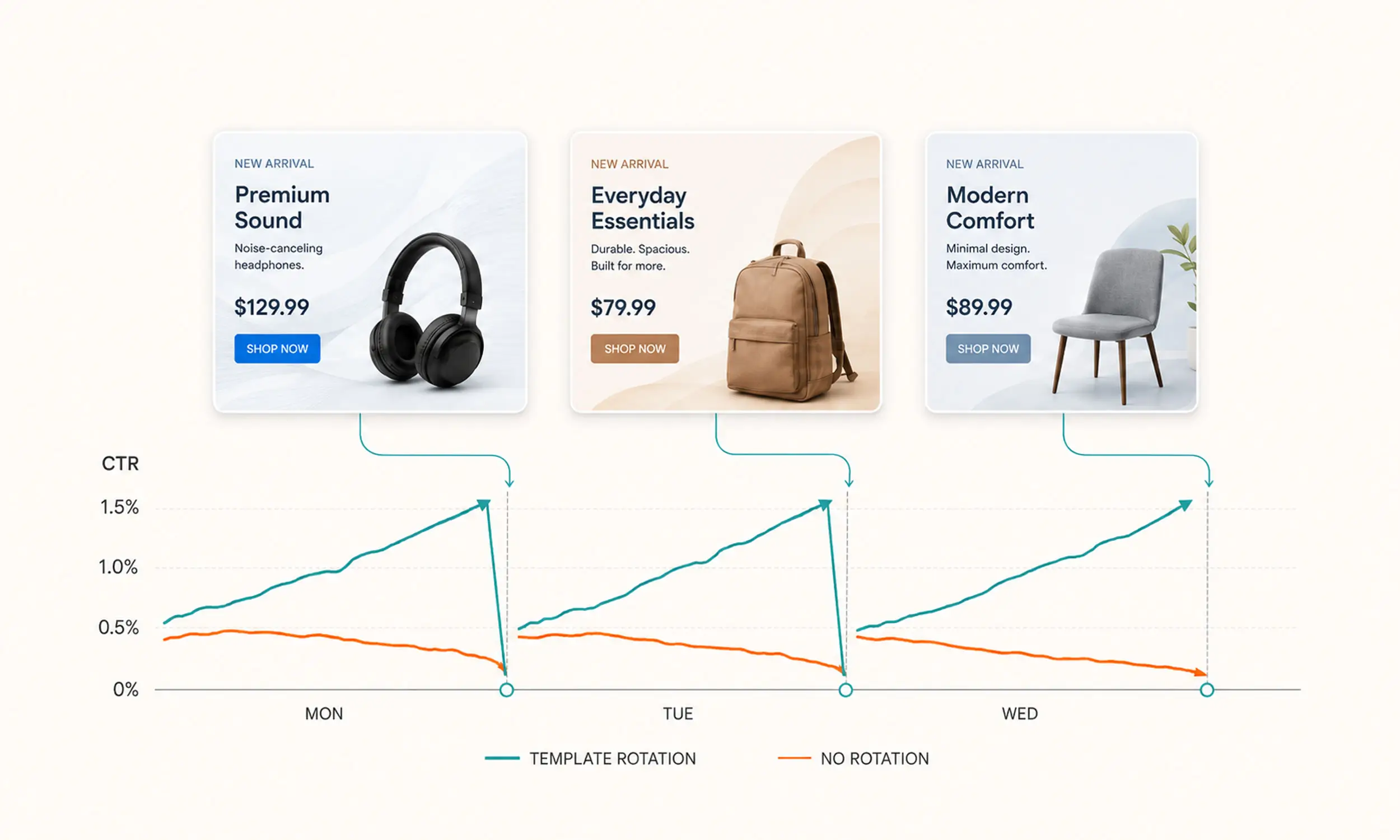
Rotation becomes a calendar, not a crisis - two or three template variants per campaign, rotated on fatigue signals or on schedule, with retired variants returning later as fresh
Seasonal changes ride the same rails - the back-to-school treatment, a sale skin, a holiday background: each is a template applied and removed, not a creative project
The template recipes most catalogs need - a clean price block, a brand frame, a promotional variant - are exactly the rotation set this playbook requires.
A rotation playbook you can run
Keep two active variants per major product set - typically a price-forward design and a brand-forward one
Set your signals in advance - a frequency level and a CTR-decay threshold that trigger rotation, so the response is mechanical, not a debate
Swap, don't stack - replace the fatigued variant rather than adding a third; audiences reset on the new look faster when the old one leaves
Test new directions on the catalog directly - a candidate template runs live on a product set for a few days against the incumbent; keep whichever wins
Rest and reuse - a retired variant returning after weeks away performs as fresh creative; the library compounds instead of resetting
Leave the campaign structure alone - rotation should never mean rebuilding campaigns or resetting learning; the products, sets, and budgets stay put while the creative changes
That's the whole system. The work moves from producing images to maintaining a small template library - and the library is reusable in a way last week's statics never were.
From production treadmill to template library
This article's argument is, concretely, Flow's model: catalogs connect once, templates carry the designs, and a refresh or a test is a template change applied across the products it covers - with synchronized product data underneath, and your store's images untouched. Teams that were producing single images weekly move that effort into template variants they rotate and reuse; the fatigue response becomes a switch they flip, and the testing cadence drops from weeks to days.
FAQ
How do I know my ads are fatigued and not just seasonal?
Fatigue shows as frequency climbing while CTR decays against your own baseline, without market-wide changes. Seasonal dips hit reach and demand broadly; fatigue is specific to audiences who've seen the creative repeatedly.
How often should catalog ad creative be refreshed?
On signals rather than a fixed calendar: set frequency and CTR-decay thresholds in advance, and rotate when they trip. With templates, the cost of rotating is low enough that acting early is safe.
Do I need many templates to fight fatigue?
Two or three variants per major product set is a working rotation. Retired variants come back later as fresh creative, so the library grows slowly and compounds.
Is rotating templates better than making new single-image ads?
It changes the economics: one design change refreshes every product in the campaign, and a new direction can be tested live on the catalog in days. Single-image production still has a place for hero moments - it just shouldn't be the whole fatigue response.
Will refreshing creative reset my campaign's learning?
Rotation as described here changes the creative inside existing campaigns and sets - structure, budgets, and audiences stay put. That's part of the point: escape the fatigue without rebuilding what's working.
Final thoughts
Ad fatigue never stops arriving - the question is what it costs you each time. Paid weekly in hand-made images, it's a tax that grows with your catalog. Paid once in a template library with a rotation habit, it's a switch you flip when the signals say so.
Build the two or three variants, set the thresholds, and let the catalog do what catalogs do: multiply one good decision across every product you sell.


Join The Newsletter
Stay ahead in catalog advertising
Get practical guides, product updates, new templates, and best practices for Dynamic Product Ads, creative automation, and ecommerce marketing.
On this page
Related articles


Launch catalog ads with ease
Ready to launch better catalog ads?
Turn product catalogs into publishing-ready creatives in minutes.