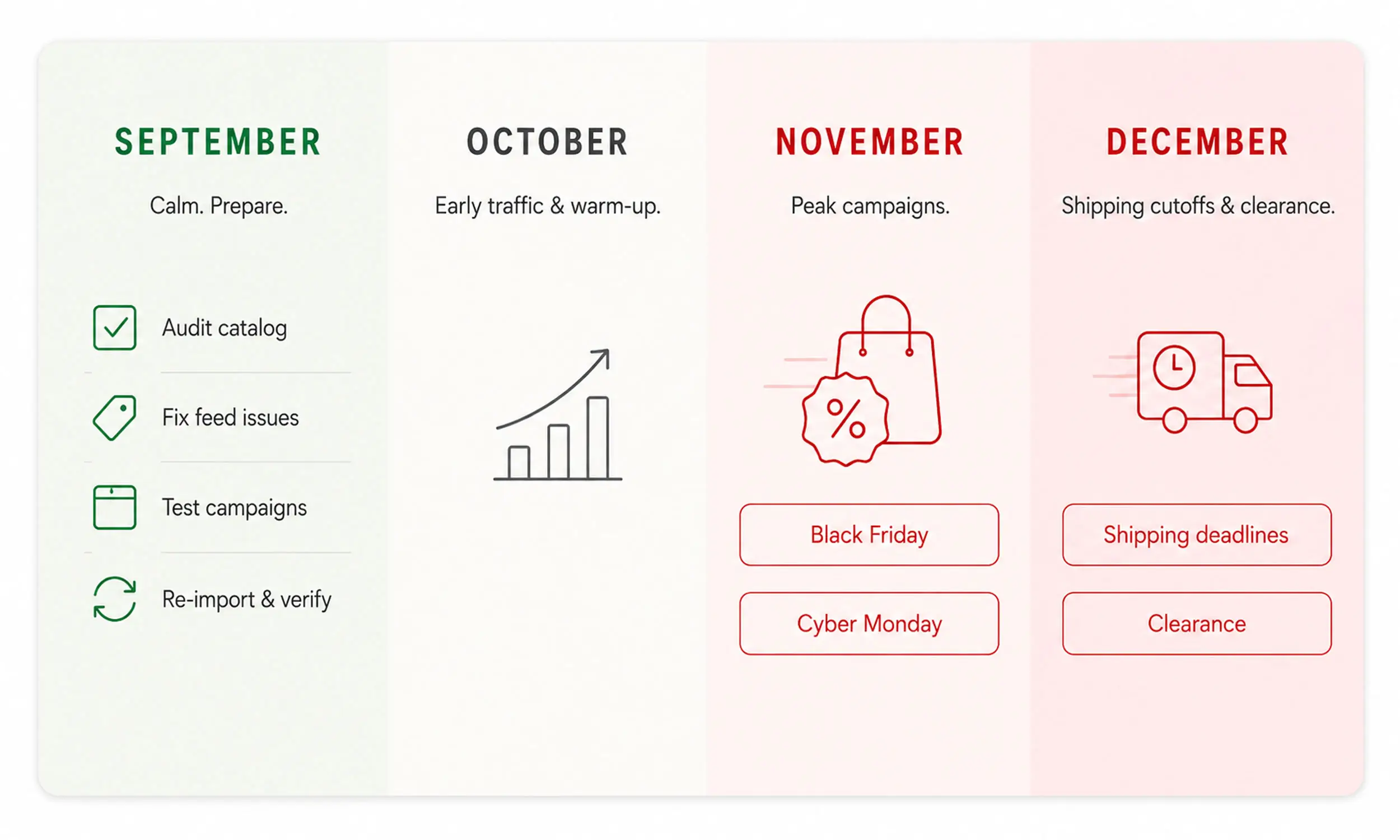
Q4 is not one event. It's a chain of them: early gifting traffic, the Black Friday and Cyber Monday compression, December shipping cutoffs, then clearance - and each link stresses your catalog in a different way. Prices change faster, inventory moves faster, campaigns multiply, and the cost of a feed problem goes from annoying to expensive.
Most teams prepare for the sale and forget the quarter. They build Black Friday creative in early November, discover a rejection backlog the same week, and spend peak season firefighting problems that were visible - and cheap to fix - months earlier.
September is the last calm month. It's the last stretch where a broken field mapping is a ticket instead of an incident, where a template test costs you nothing but a few days of normal traffic, and where nobody minds if you re-import a catalog. Treat it as a working month, not a waiting month.
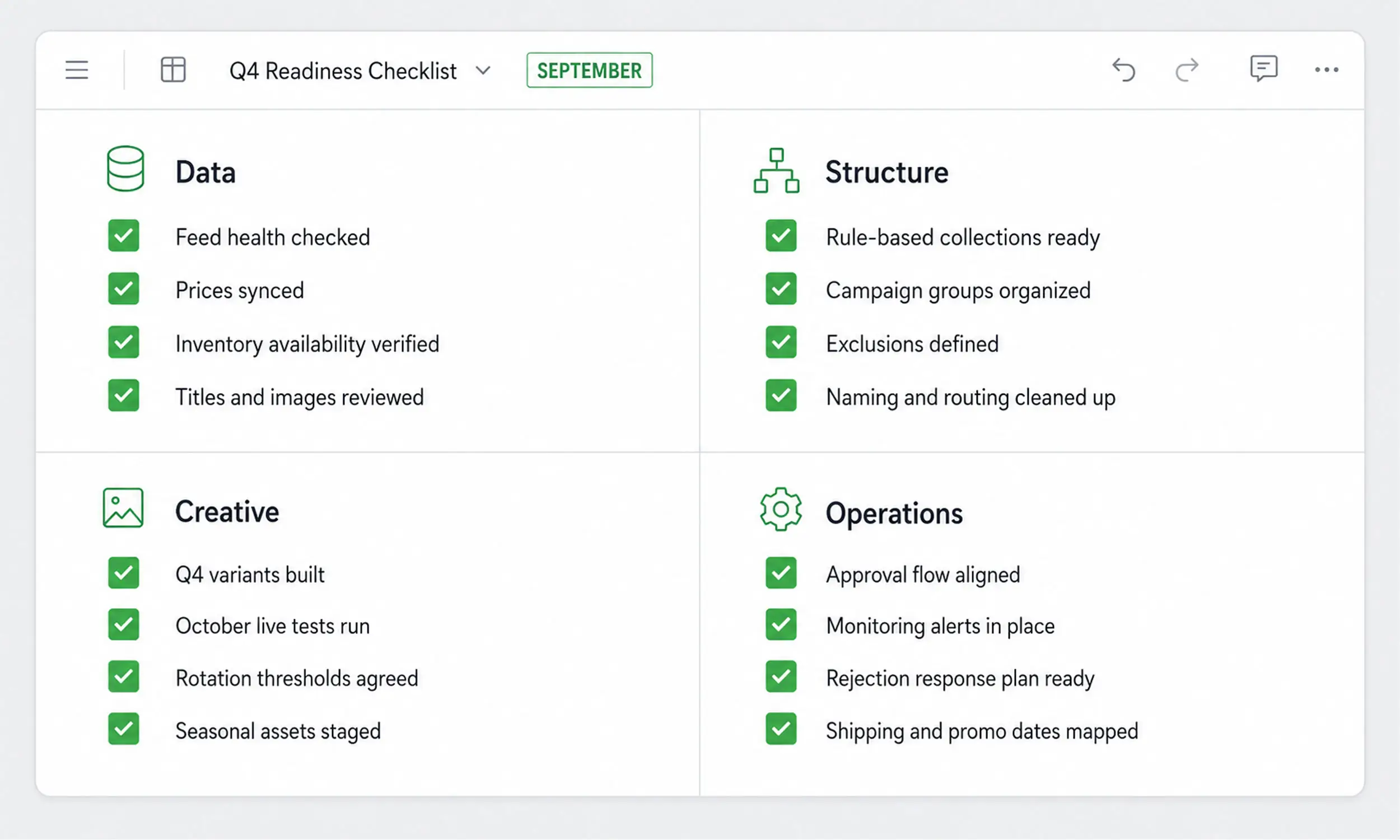
This checklist covers four kinds of readiness. Work through them in order - each one is easier when the previous one is done.
Data readiness: fix the feed while fixes are cheap
Everything else in Q4 rides on the feed. A campaign can't sell a product the platform rejected, and a sale can't show a price the feed never delivered.
Clear every standing rejection. Items sitting in a rejected or flagged state today are products missing from every Q4 campaign you'll run. Work through the common catalog errors now, while each fix can be verified without pressure.
Raise your sync cadence before you need it. A refresh schedule that was fine for a stable summer catalog can serve stale prices and sold-out products during peak, when inventory turns over daily. Product feed management covers the cadence mechanics - the September job is simply to raise yours and confirm the syncs complete cleanly.
Test your sale price fields on real products. Apply sale pricing to a small set of items, push it through the feed, and check how the discount renders in actual placements. November is the wrong month to learn that your sale fields are mapped incorrectly or that strikethrough pricing doesn't appear the way you expected.
Spot-check the long tail. Bestsellers get looked at constantly; the products that only surface during gifting season often haven't been reviewed since spring. Preview a sample of them - titles, images, availability - before Q4 traffic finds them first.
Structure readiness: build the collections now, fill them later
November campaigns are assembled from structure that exists beforehand. Teams that try to invent segmentation mid-peak end up with rushed filters, mislabeled products, and campaigns targeting the wrong slice of the catalog.
Collections are the tool for this, and September is when they should be created - even the ones that stay empty for weeks.
A gifting collection. Products that work as gifts, grouped now so gift-focused campaigns can launch the day you want them, not the day the grouping is finished.
A bestsellers collection. Your proven performers, ready to carry prospecting pushes when budgets scale up.
A clearance collection. Empty in September is fine - it exists so that end-of-season markdowns have somewhere to land instantly instead of triggering a scramble in late December.
Mirror the ones that matter on-platform. Collections that drive campaigns should have matching product sets on the platform side, created and verified before campaign build-out starts.
The rule: any grouping you expect to advertise in Q4 should exist, be named sensibly, and have its membership rules tested before October.
Creative readiness: variants built and tested before November
Q4 creative fails in a predictable way - the sale template gets designed the week of the sale, ships untested, and any problem it has plays out at peak spend.
Build the Q4 template variants now. At minimum: a sale treatment with clear discount presentation, a gifting or holiday treatment, and your standard look. Three variants cover most of the quarter's needs.
Test them in October on live traffic. Run each variant on a product set for a stretch and compare against your incumbent. October traffic is cheap tuition; you learn which price treatment and which layout your audience responds to before the weeks where it matters.
Agree rotation thresholds in advance. Peak-season frequency climbs fast, and ad fatigue arrives sooner than in a normal month. Decide now what signal triggers a template swap, so the mid-November response is mechanical instead of a meeting.
Stage the assets your templates depend on. Badges, backgrounds, brand marks, seasonal elements - collected and approved in September, so a variant swap in November is a switch and not a design request.
Operational readiness: decide who watches, and when to freeze
The least glamorous readiness is the one that saves peak weeks. Two decisions, made now and written down:
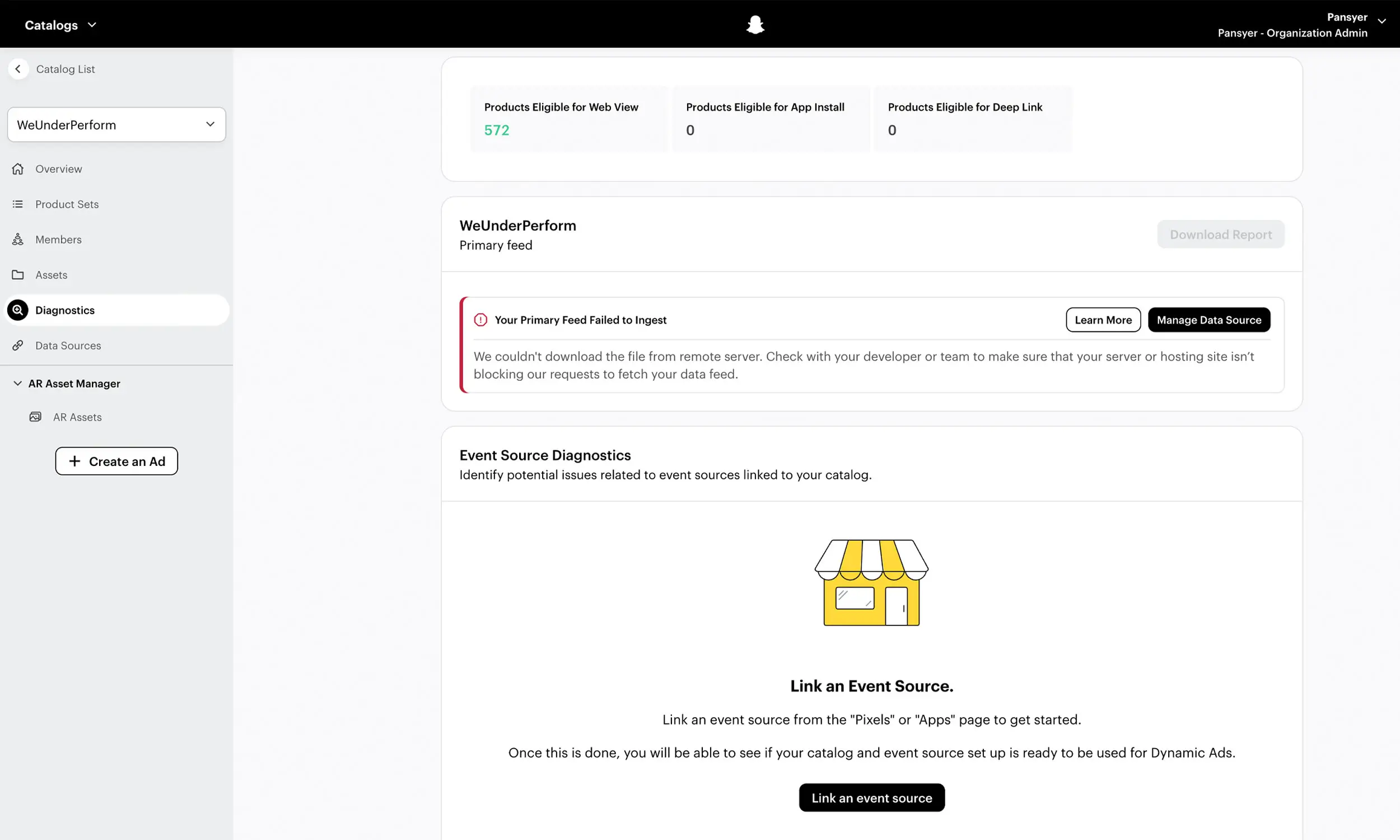
Name the person who watches diagnostics. During peak weeks, someone specific - not "the team" - checks catalog diagnostics and feed health every morning. Most rejection and sync problems are recoverable if caught the day they appear and damaging if caught a week later. Decide who owns that look, and where they look (Commerce Manager diagnostics on the Meta side, plus your feed tool's health view).
Set freeze windows for feed and structure changes. In the days around each major sale event, no mapping changes, no re-imports, no catalog restructuring - changes queue for after. The riskiest moment for a feed is right after someone improves it, and peak week is the wrong time for that risk.
Write down the rollback. If a sale price push goes wrong, who reverts it, and how? A rollback plan defined in September takes minutes; the same plan improvised during an incident takes hours.
Pre-agree the money decisions. Scaling rules and spend ceilings decided calmly in advance beat decisions made mid-sale.
Running the September pass in Flow
The checklist above maps directly onto a Flow workflow. Feed validation and health monitoring surface rejections and sync issues in one view, which makes the data pass a review session instead of an archaeology project - and gives your peak-week diagnostics owner a single place to look each morning.
Structure readiness is a September afternoon: build the gifting, bestsellers, and clearance collections in the catalog engine, and they stay synchronized with product data as inventory shifts through the quarter.
Creative readiness is where the template model pays off. Q4 variants are built once as reusable templates - with brand assets staged and backgrounds handled - and applied across every product in a collection, so an October test or a November rotation is a template change, not a production cycle. The same structure then feeds your Meta, TikTok, Pinterest, and Snapchat workflows without rebuilding anything per platform.
None of this makes Q4 easy. It makes Q4 boring in the right places - which is the goal.
FAQ
When should I start preparing my catalog for Q4?
September. It leaves enough runway to fix rejections, test sale pricing, and trial creative variants on live traffic before campaigns scale. Starting in late October means every problem you find is found under pressure.
What should I check first?
Standing rejections. Every rejected item is a product missing from every campaign you'll run this quarter, and rejection fixes are the readiness work with the longest verification loop - start them earliest.
How do I test sale pricing before the actual sale?
Apply sale fields to a small set of products, push the feed, and check the rendered result in real placements. You're testing the pipeline - mapping, sync, display - not the discount itself.
Do I really need a clearance collection in September?
It can sit empty for months. The point is that structure created calmly is correct, and structure created during a markdown scramble usually isn't. An empty collection costs nothing to hold.
What is a feed freeze window?
A short period around a major sale event where feed mappings, imports, and catalog structure don't change - only prices and inventory flow through the existing pipeline. It removes self-inflicted incidents from the weeks that can least afford them.
Final thoughts
Every Q4 postmortem contains the same sentence: "we knew about that in October." The rejections were visible, the sale fields were untested, the collections didn't exist, and nobody had agreed who was watching.
The September checklist is the cheap version of those lessons. Four passes - data, structure, creative, operations - done in the last calm month, so that when the quarter accelerates, your catalog is the part of the operation you don't think about.


Join The Newsletter
Stay ahead in catalog advertising
Get practical guides, product updates, new templates, and best practices for Dynamic Product Ads, creative automation, and ecommerce marketing.
On this page
Related articles


Launch catalog ads with ease
Ready to launch better catalog ads?
Turn product catalogs into publishing-ready creatives in minutes.