Every store that advertises on Meta, TikTok, Snapchat or Pinterest eventually hits the same fork: design each ad by hand, or connect a product catalog and let the platform assemble ads from it. Both modes work. Both have believers. And most advice about them is written by someone selling one of the two.
The reality is less dramatic: they're different tools for different jobs, and the right first choice depends on the shape of your store - how many products you sell, how often they change, and how much creative say you need over every pixel.
This guide compares the two modes on the axes where they actually differ, then gives you a decision framework by situation - including the most common ending, which is running both.
The two modes in one minute
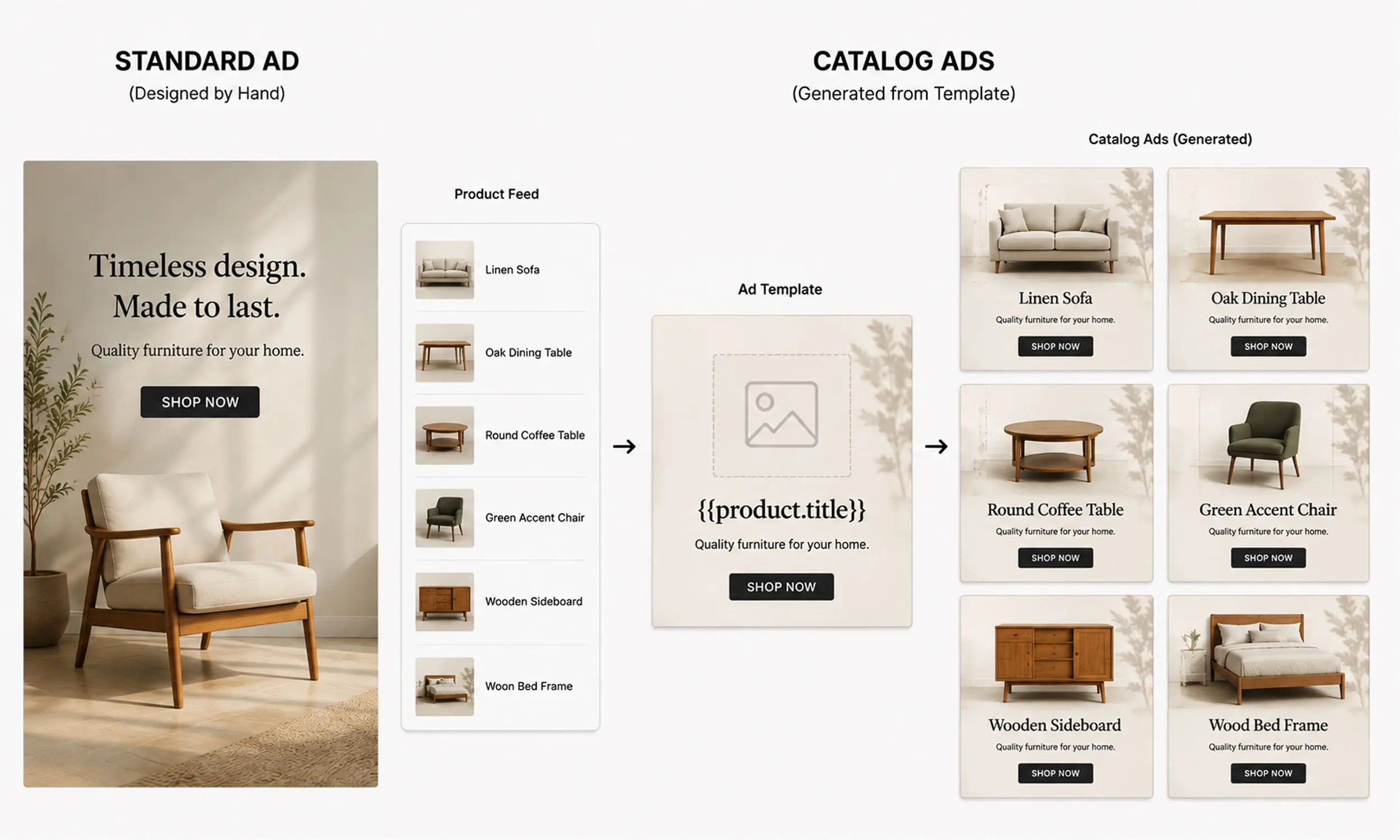
A standard ad is hand-built: you compose an image or video, write the copy, and ship that exact creative to an audience. What you make is what everyone sees.
A catalog ad is assembled: you connect a product feed, and the platform generates an ad per product - choosing which products each person sees and rendering them into placements automatically. If the model is new to you, what catalog ads are covers the foundations.
That's the whole definitional difference. Everything else - effort, control, scale, upkeep - follows from it.
Where they actually differ
Setup effort
A standard ad needs nothing but a finished creative and an ad account - the first one can be live this afternoon. Catalog ads need a product feed first, which means getting product data clean and structured - real upfront work, covered in product feed management.
The trade is simple: standard ads cost a little effort every time, catalog ads cost more effort once.
Creative control
Standard ads win this outright: every pixel is a decision you made. Catalog ads, by default, drop your product photo into a placement with minimal styling - which is why so many catalog ads look the same.
Templates narrow the gap considerably - a designed layout the products render through, the subject of catalog ad design - but a hand-composed hero image still offers a level of control no template matches.
Scale with catalog size
This is the axis that flips everything. Standard production scales with your output: more products means more design work, forever. Catalog ads scale with the feed: one setup covers the assortment, and a new product is a data row, not a design project.
Somewhere along a store's growth curve, hand production stops being able to cover the catalog. Past that point, this stops being a real choice.
Personalization
A standard ad shows everyone the same thing. Catalog ads pick per person - a shopper who browsed a specific product can be shown that product, and prospecting audiences see the items the platform predicts they'll respond to. This is the engine behind dynamic product ads, and it isn't something hand-built creative can replicate.
Maintenance
Standard creative decays and has to be remade - a recurring production tax explored in the ad fatigue playbook. Catalog ads maintain themselves at the data layer: prices, stock, and new arrivals flow in from the feed, and a creative refresh is a template change rather than a new production cycle.
Which should your store run first?
Tiny catalog or one hero product: standard first
If you sell a handful of products - or one product carries the store - hand-crafted ads are the right call. Each product can get the attention a feed pipeline exists to avoid, and the catalog machinery would be overhead without a payoff yet.
Catalog ads can come later, usually when retargeting people on the specific products they browsed starts to matter more than polishing individual creatives.
Growing catalog: catalog ads carry the assortment
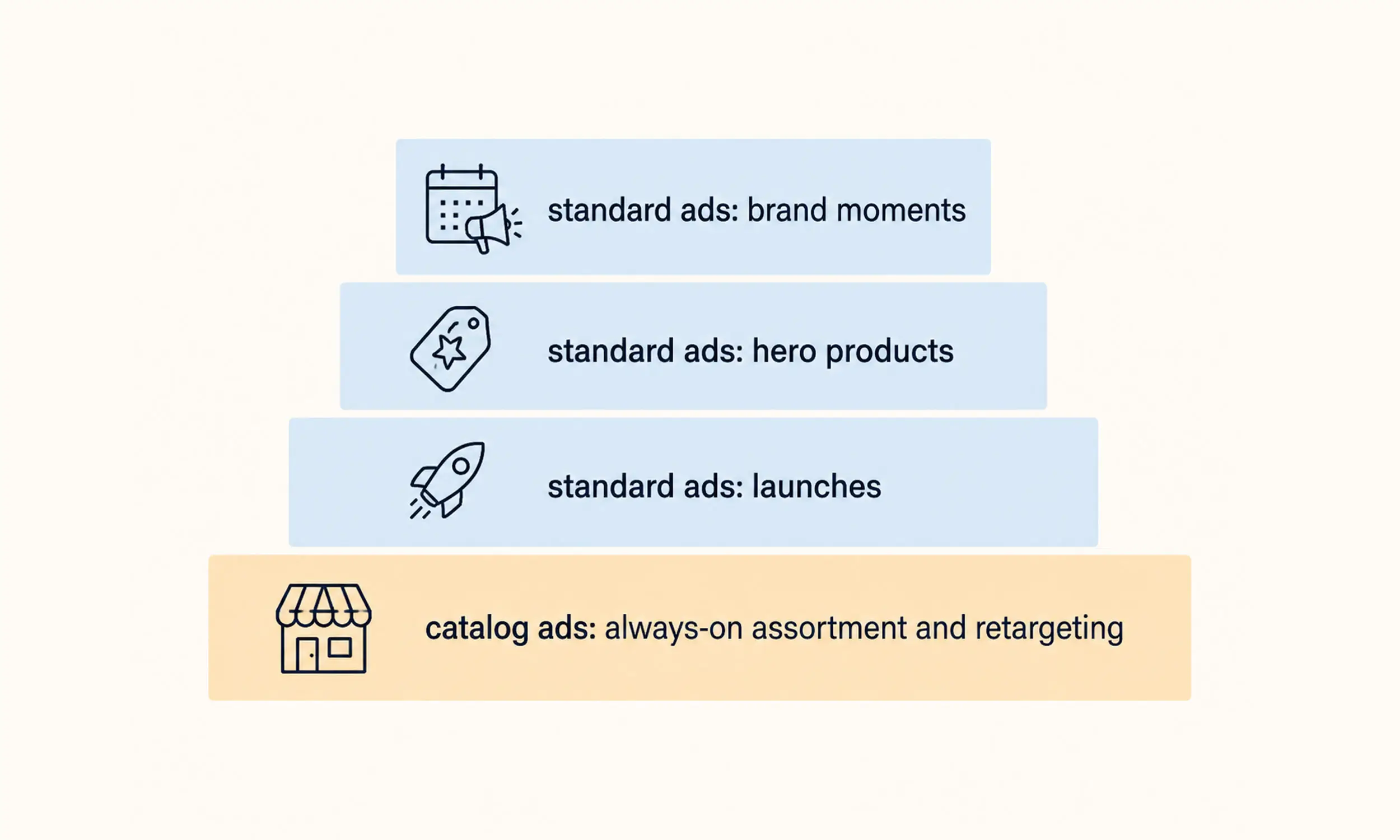
Once there are more products than anyone will ever design individual ads for, the equation flips. Catalog ads become the only way the full assortment gets advertised at all - always-on retargeting plus broad coverage - while standard ads narrow to what they're best at: hero products, launches, and moments that deserve a composed message.
The mistake to avoid here is treating standard ads as the "real" ads and the catalog as a side project. At this size, it's the reverse: the catalog is the base layer doing the volume work.
Most stores: both, in layers
Mature accounts converge on the same structure. Catalog ads run continuously underneath - retargeting, assortment prospecting, the long tail. Standard ads sit on top for campaigns, brand storytelling, and the products worth a bespoke treatment.
They're complements, not rivals. The question was never really "which" - it's "which first," and then "which job does each one own."
Signals it's time to add the other mode
If you run only standard ads, add catalog ads when:
Products sell without ads ever being made for them, because there's no time
Retargeting shows one generic ad no matter what a visitor browsed
Price and stock changes are outrunning your ability to update creatives
New arrivals sit waiting for a design slot before their first impression
If you run only catalog ads, add standard ads when:
A launch or promotion needs a single composed message no template expresses
You're building brand, and a product grid isn't the story
One product is clearly carrying the store and deserves its own crafted moment
The control objection, and what closes it
The most common reason stores delay catalog ads isn't the setup - it's the fear that their ads will look like everyone else's raw product photos. That objection is fair for default rendering, and it's exactly what templates exist to answer.
This is the gap Flow is built around. Import the catalog once - from Meta Catalogs or a CSV/XML feed - and render every product through reusable templates: your backgrounds, your brand assets, your price treatment, with background removal for products shot on cluttered surfaces. Feed validation and product previews let you see how the assortment renders before any ad runs.
The point isn't that templated catalog ads beat hand-made heroes - it's that they carry your design language at catalog scale, so choosing catalog ads stops meaning giving up the look. The decision stops being control versus scale and becomes what it should have been all along: which jobs each mode does.
FAQ
Are catalog ads better than standard ads?
Neither wins universally. Catalog ads win on scale, personalization, and maintenance; standard ads win on per-ad creative control. The useful question is which jobs your store has - and most stores have both kinds.
Should a small store with a few products use catalog ads?
Usually not first. With few products, hand-building gives each one full attention, and feed setup is overhead without a payoff yet. Catalog ads earn their place as the range grows, or when browsed-product retargeting starts to matter.
Do catalog ads eventually replace standard ads?
Rarely. Mature accounts tend to run catalog ads as the always-on base and standard ads for launches, hero products, and brand moments. The mix shifts as the catalog grows, but both usually stay.
Are catalog ads harder to set up?
Harder up front - a clean product feed is required work before anything runs. Standard ads are the mirror image: easy to start, expensive to sustain. Over a growing catalog, up front tends to be the better place to spend the effort.
Why do catalog ads look worse than my designed ads?
Default rendering places raw product photos into placements with minimal styling. Templates close most of that gap by rendering products through a designed layout instead - which is what makes catalog scale viable for brands that care how their ads look.
Final thoughts
Start with the mode that fits your catalog today: standard ads while every product can get real attention, catalog ads once the assortment outgrows hand production. Then treat the other mode as a layer, not a rival.
The stores that get this right stop debating which format is better and start assigning jobs: the catalog covers everything you sell, and the hand-made ads show up where craft actually moves the needle.


Join The Newsletter
Stay ahead in catalog advertising
Get practical guides, product updates, new templates, and best practices for Dynamic Product Ads, creative automation, and ecommerce marketing.
On this page
Related articles



Launch catalog ads with ease
Ready to launch better catalog ads?
Turn product catalogs into publishing-ready creatives in minutes.