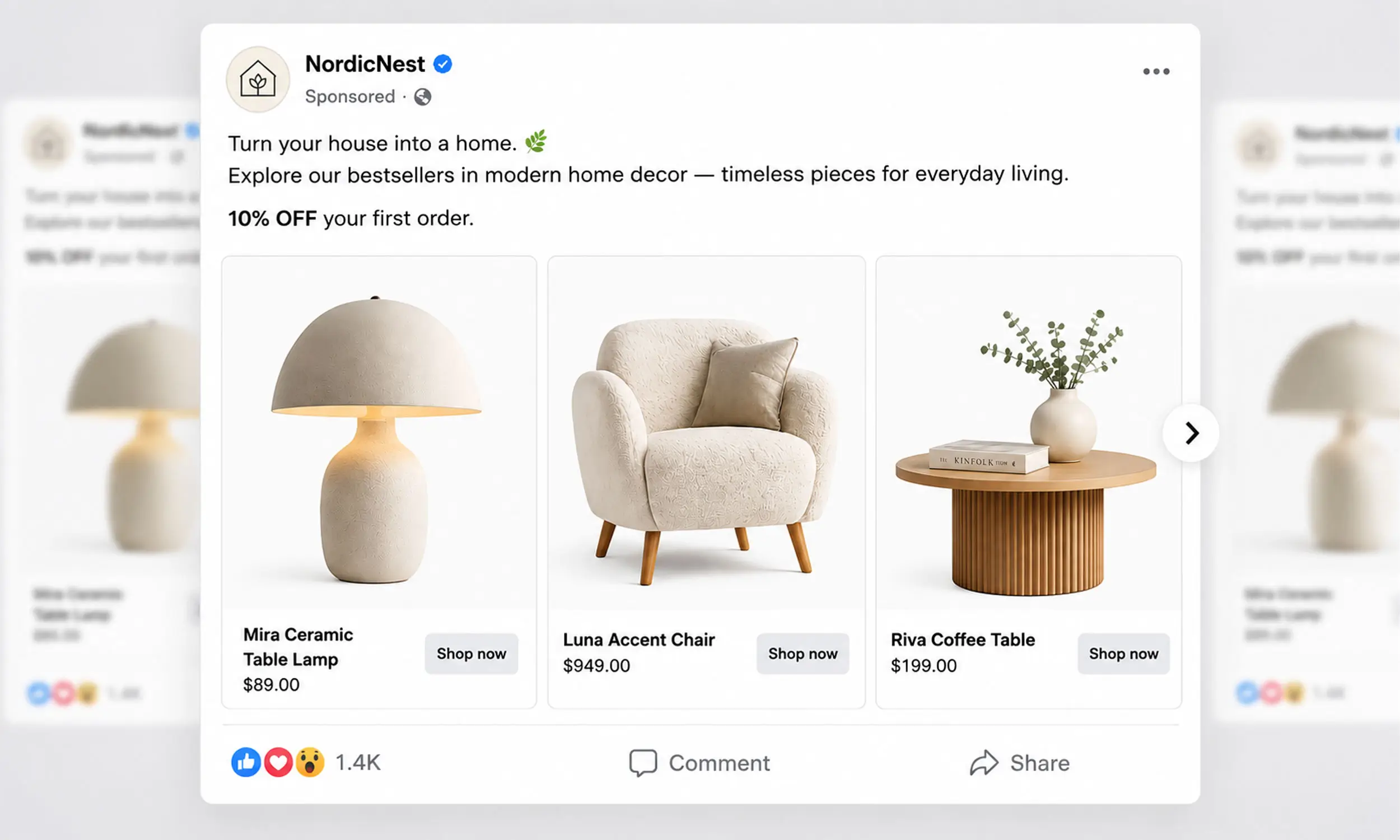
Open Facebook, Instagram, TikTok, Pinterest, or Snapchat and you'll quickly notice something. Most catalog ads look almost identical:
A product image;
A price;
Sometimes a discount badge;
Then another product;
Then another.
Although they're promoting completely different brands, many catalog ads feel interchangeable. The reason isn't the advertising platform. It's how most brands build their catalog creatives.
New to catalog advertising? Read our guide: What Are Catalog Ads
The product image isn't the problem
Most ecommerce product images are created for one purpose: helping customers evaluate a product on a product page. They're usually photographed on a clean background with consistent lighting and minimal distractions.
That's exactly what an ecommerce store needs. Advertising, however, has a completely different objective. Instead of helping someone compare products, an ad has to stop the scroll first.
A catalog creative needs to communicate:
Promotions
New arrivals
Seasonal campaigns
Brand identity
Product value
All within a fraction of a second. Using the exact same product image for both jobs often produces ads that feel generic.
Every platform starts with the same product feed
Whether you're advertising on Meta, TikTok, Pinterest, or Snapchat, the workflow is remarkably similar. Each platform reads information from a product catalog and automatically generates ads using the available product data.
The technology changes.The product feed doesn't.
Platform | Uses product feed | Supports catalog ads |
|---|---|---|
Meta | Yes | Yes |
TikTok | Yes | Yes |
Yes | Yes | |
Snapchat | Yes | Yes |
Want to understand how Meta uses the same product data? Read our Meta Catalog Ads: Complete Guide.
Why Catalog Ads start looking identical
Automation solves one problem - scale. It doesn't automatically solve creativity. When every campaign uses:
the same product image;
the same layout;
the same visual hierarchy;
the same white background.
Every advertisement begins to blend into the feed. Even different promotions often end up looking almost identical. The platform delivers the right product.
The creative still has to convince someone to stop scrolling.
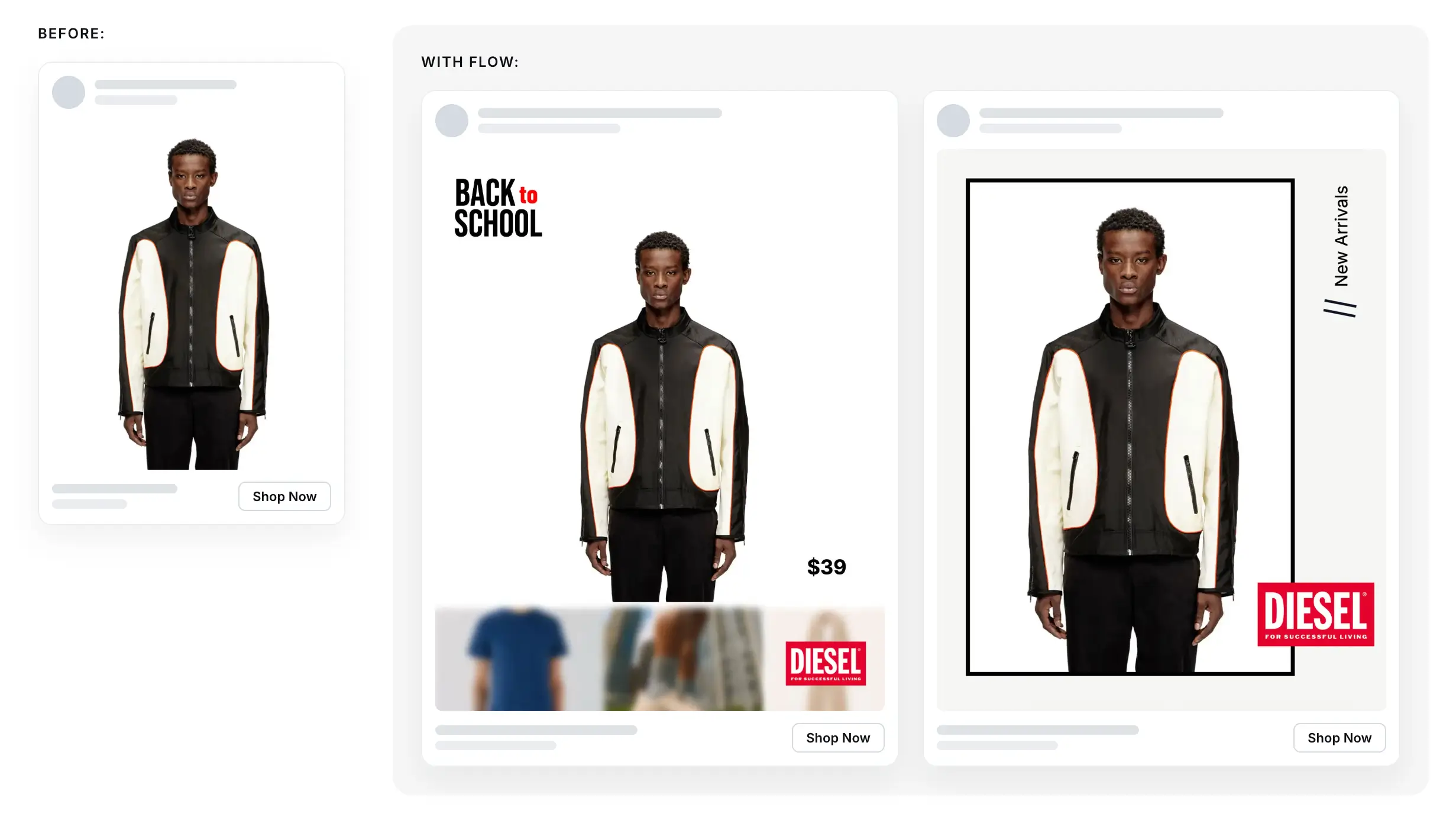
Standard Catalog Ad vs campaign creative
Neither approach is wrong. They simply solve different problems.
Standard catalog Ad | Campaign creative |
|---|---|
Uses the original product image | Adds campaign-specific creative elements |
Minimal branding | Strong visual identity |
Same layout for every campaign | Different concepts for different promotions |
Product-focused | Campaign-focused |
Limited promotional messaging | Highlights offers, collections, and brand personality |
What better Catalog Ads do differently
The best ecommerce brands don't replace automation. They build on top of it.
Instead of generating every ad from the same layout, they create reusable creative systems that automatically combine product data with campaign design.
Examples include:
promotional backgrounds;
seasonal colors;
discount treatments;
branded layouts;
collection-specific templates;
lifestyle imagery;
product badges.
The product information remains synchronized. The creative becomes much more engaging.
Design for the campaign, not just the product
One of the biggest mistakes brands make is treating every catalog campaign the same.
A Summer Sale shouldn't look like a New Arrivals campaign. A Black Friday promotion shouldn't share the same creative as an evergreen catalog.
Different campaigns deserve different visual identities. Many ecommerce teams now organize reusable templates by:
New Arrivals
Summer Sale
Black Friday
Best Sellers
Category Promotions
Clearance
This creates consistency without sacrificing variety.
How Flow helps
Flow sits between your product catalog and your advertising platforms. Instead of replacing your existing catalog, it transforms the way products are presented across Meta, TikTok, Pinterest, and Snapchat.
Using reusable templates, brands can:
generate multiple creative concepts from the same product feed;
organize campaigns by collections;
keep prices and product information synchronized;
create dedicated advertising creatives without changing the original ecommerce product images.
See how ecommerce brands use Flow in real campaigns by exploring our customer stories.
Best practices
Create separate templates for different campaign types.
Keep website product images separate from advertising creatives.
Make pricing easy to scan.
Use campaign-specific colors and branding.
Organize products into collections instead of using one design for everything.
Test multiple creative concepts for the same catalog.
Final thoughts
Catalog advertising has made it possible to promote thousands of products without managing thousands of individual ads.
But automation alone doesn't make great advertising. The brands that stand out understand that product data and creative design solve different problems.
The catalog keeps information accurate. The creative captures attention. Combining both is what transforms ordinary catalog ads into campaigns that feel distinctive across every platform.


Join The Newsletter
Stay ahead in catalog advertising
Get practical guides, product updates, new templates, and best practices for Dynamic Product Ads, creative automation, and ecommerce marketing.
On this page
Related articles



Launch catalog ads with ease
Ready to launch better catalog ads?
Turn product catalogs into publishing-ready creatives in minutes.