Meta Catalog Ads have become one of the most effective advertising formats for e-commerce businesses. Instead of creating separate ads for every product, Meta automatically uses information from your product catalog to generate personalized ads across Facebook and Instagram.
For brands with hundreds or thousands of products, this makes advertising significantly easier to manage and scale. But while Meta automates product delivery, it doesn't automatically create better advertising.
Most e-commerce brands still rely on the same product images used on their website, which often results in catalog ads that look almost identical to every other advertiser in the feed.
Understanding how Meta Catalog Ads work and where creative optimization makes the biggest difference is essential for building campaigns that not only scale, but also stand out.
What Are Meta Catalog Ads
Meta Catalog Ads are advertisements generated automatically using data stored inside a Meta Catalog.
Instead of manually building every advertisement, Meta combines information from your catalog, including product images, titles, prices, availability, and links, to generate ads dynamically. This makes Meta Catalog Ads particularly useful for e-commerce brands with frequently changing inventories, seasonal promotions, and large product catalogs.
Unlike traditional image ads, the creative is connected directly to your catalog. Whenever product information changes, Meta automatically updates the ad with the latest available data.
This significantly reduces manual work while ensuring product information remains accurate across campaigns.
Related: If you're new to catalog advertising, start with our guide: What Are Catalog Ads

What makes up a Meta Catalog
A Meta Catalog is the data source behind every catalog campaign. It contains structured product information that Meta uses to build ads automatically. Typical catalog fields include:
Catalog field | How it is used |
|---|---|
Product image | Main product visual |
Product title | Product name shown in the ad |
Price | Current product price |
Sale price | Promotional price, when available |
Availability | Current stock status |
Product URL | Destination product page |
Brand | Brand information |
Category | Product grouping and product sets |
This information can be imported from platforms like Shopify, Meta Commerce Manager, or through CSV and XML product feeds. If you'd like to understand how product catalogs are imported, validated, and organized before they're used in advertising, see our guide to the catalog engine.
Learn more: Meta Catalog integration
Meta catalog ads vs standard image ads
Meta catalog Ads | Standard image ads |
|---|---|
Generated from catalog data | Built as fixed creatives |
Product details can update automatically | Updates require editing the ad |
Suitable for large product ranges | Better for individual concepts or hero products |
Meta can select relevant products dynamically | The advertised product is fixed |
Creative flexibility depends on the catalog setup | Full control over the design |
Why e-commerce brands use Meta Catalog Ads
Meta Catalog Ads solve one of the biggest challenges in e-commerce advertising: scale.
Instead of maintaining hundreds or thousands of individual advertisements, brands connect their catalog once and let Meta automatically deliver relevant products to potential customers. Some of the biggest advantages include:
Automatic product synchronization
Dynamic pricing and availability
Large catalog support
Product retargeting
Collection-based campaigns
Easier campaign management
For many e-commerce brands, catalog campaigns become a core part of their paid social strategy.
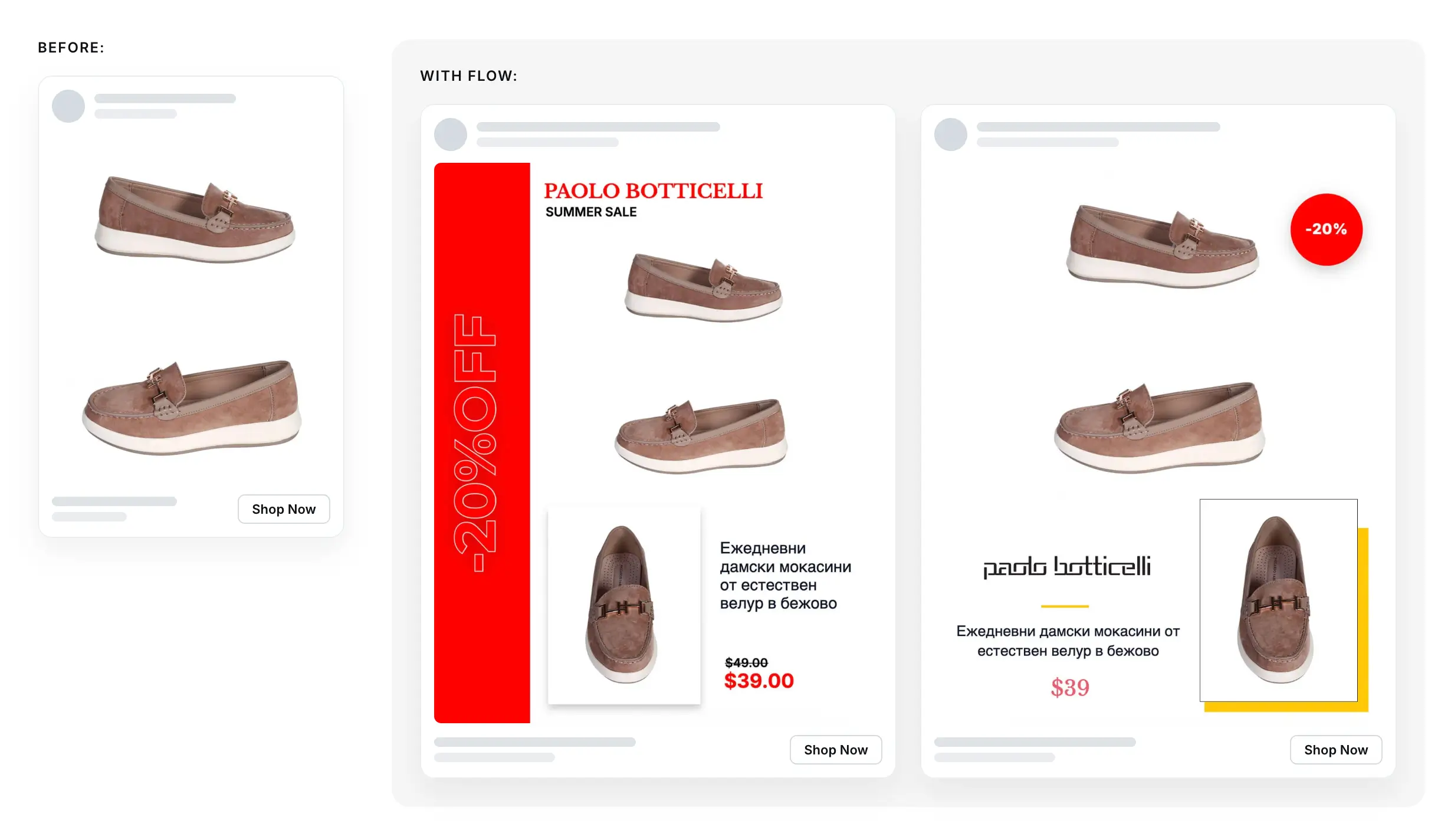
Example of a Meta carousel ad by Paolo Botticelli
Where Meta Catalog Ads fall short
Automation makes campaigns easier to manage but it doesn't automatically make them more engaging.
Most Meta Catalog Ads use the same product images displayed on the e-commerce website. While those images are ideal for product pages, they often provide little room for:
promotional messaging;
seasonal branding;
campaign-specific backgrounds;
stronger visual hierarchy;
differentiated creative concepts.
As a result, many catalog ads become visually similar, making it harder to stand out in increasingly competitive feeds. This is exactly where creative optimization becomes just as important as the product catalog itself.


Join The Newsletter
Stay ahead in catalog advertising
Get practical guides, product updates, new templates, and best practices for Dynamic Product Ads, creative automation, and ecommerce marketing.
On this page
Related articles




Launch catalog ads with ease
Ready to launch better catalog ads?
Turn product catalogs into publishing-ready creatives in minutes.